
Hi 👋 I am Zhiyuan Peng (彭志远, Lucius Peng), a second-year Ph.D. student at the School of Computer Science, Shanghai Jiao Tong University. Previously, I was fortunate to intern at Tencent LIGHTSPEED Studios (Qingyun Program) and Microsoft Research Asia (MSRA).
My research interest is Agentic Coding. I build agents that plan, call tools, and act inside real execution environments, from a single coding agent that ships a runnable repository to a governed fleet of role-based agents. I have published papers at top international conferences such as ACL, EMNLP, FSE, and ASE.
In 2026, I am leading or participating in the following research topics:
- Agentic Coding: agents that write, run, and repair code in real execution environments
- Multi-Agent Orchestration: role-based agent teams with tool, permission, and workspace governance
- Self-Evolving Agents: distilling execution traces into reusable skills and long-term memory
Education
-
 Shanghai Jiao Tong UniversityPh.D. Student, School of Computer ScienceSep. 2024 - present
 -
 Nanjing UniversityMasterSep. 2022 - Jun. 2024
 -
 Hohai UniversityBachelorSep. 2018 - Jun. 2022
Experience
-
 Tencent LIGHTSPEED StudiosResearch Intern, Qingyun ProgramBuilt GUI agents that drive live game clients to verify generated code, producing PlayCoder (FSE'26, CCF-A).
 -
 Microsoft Research AsiaResearch InternBuilt a benchmark that takes a repository from README to a deployed, sandbox-verified service, producing RepoGenesis (ACL'26, CCF-A).
Honors & Awards
-
🥇 First Prize, National College Student English Competition (Final)2021
News
Selected Publications (view all )
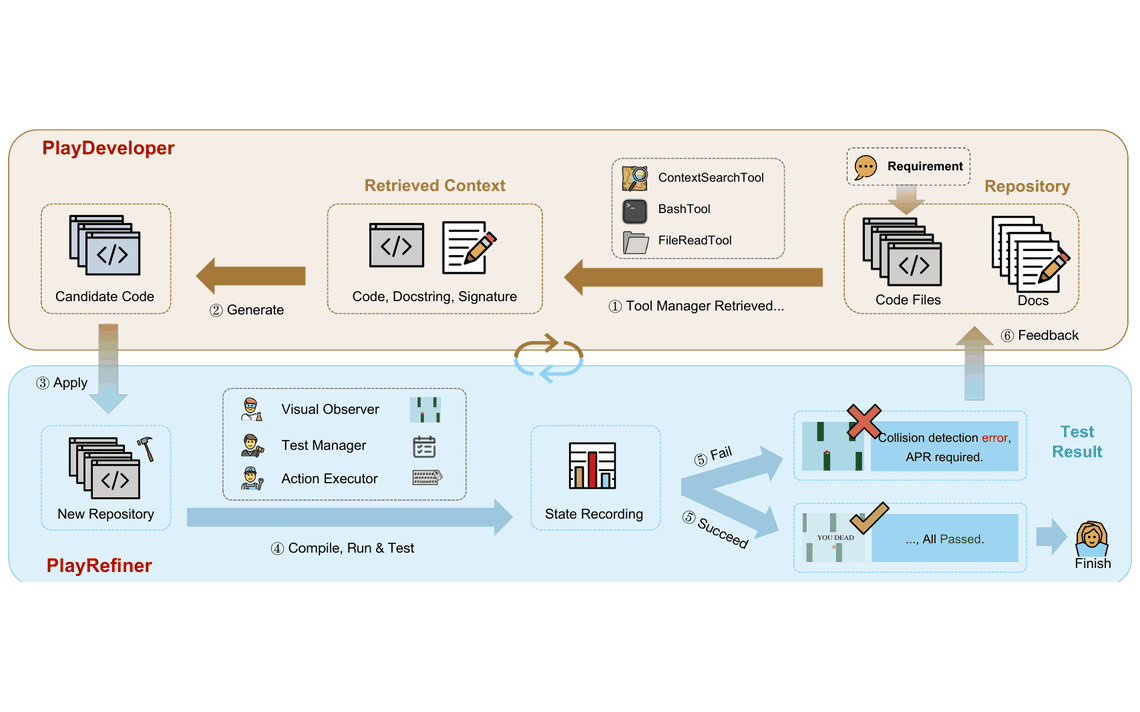
PlayCoder: Making LLM-Generated GUI Code Playable
Zhiyuan Peng, Wei Tao#, Xin Yin, Chenhao Ying, Yuan Luo, Yiwen Guo (# co-first author)
ACM Joint European Software Engineering Conference and Symposium on the Foundations of Software Engineering 2026 FSE 2026 CCF-A
A GUI agent plays the generated game the way a user would, so playability is judged by interacting with the live program instead of by inspecting static code.
PlayCoder: Making LLM-Generated GUI Code Playable
Zhiyuan Peng, Wei Tao#, Xin Yin, Chenhao Ying, Yuan Luo, Yiwen Guo (# co-first author)
ACM Joint European Software Engineering Conference and Symposium on the Foundations of Software Engineering 2026 FSE 2026 CCF-A
A GUI agent plays the generated game the way a user would, so playability is judged by interacting with the live program instead of by inspecting static code.
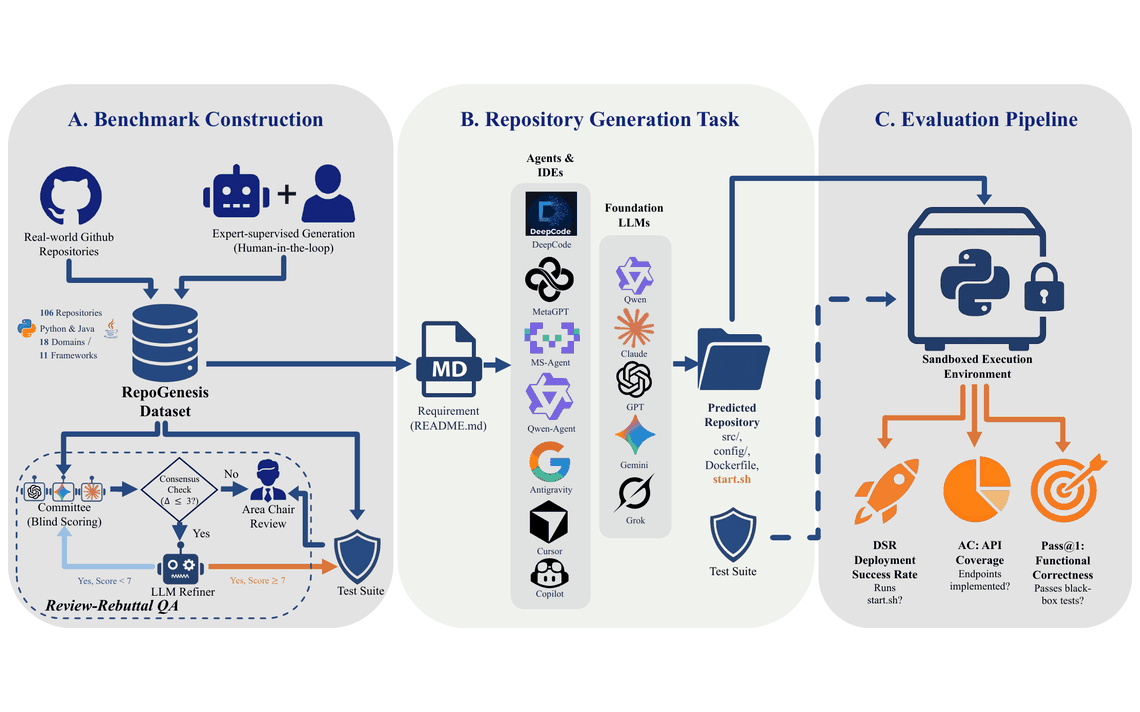
RepoGenesis: Benchmarking End-to-End Microservice Generation from Readme to Repository
Zhiyuan Peng, Xin Yin#, Pu Zhao, Fangkai Yang, Lu Wang, Ran Jia, Xu Chen, Qingwei Lin, Saravan Rajmohan, Dongmei Zhang (# co-first author)
Annual Meeting of the Association for Computational Linguistics 2026 ACL 2026 Main CCF-A
An agent reads a README and delivers a runnable multi-service repository, verified by building, launching, and calling the service inside an isolated sandbox.
RepoGenesis: Benchmarking End-to-End Microservice Generation from Readme to Repository
Zhiyuan Peng, Xin Yin#, Pu Zhao, Fangkai Yang, Lu Wang, Ran Jia, Xu Chen, Qingwei Lin, Saravan Rajmohan, Dongmei Zhang (# co-first author)
Annual Meeting of the Association for Computational Linguistics 2026 ACL 2026 Main CCF-A
An agent reads a README and delivers a runnable multi-service repository, verified by building, launching, and calling the service inside an isolated sandbox.
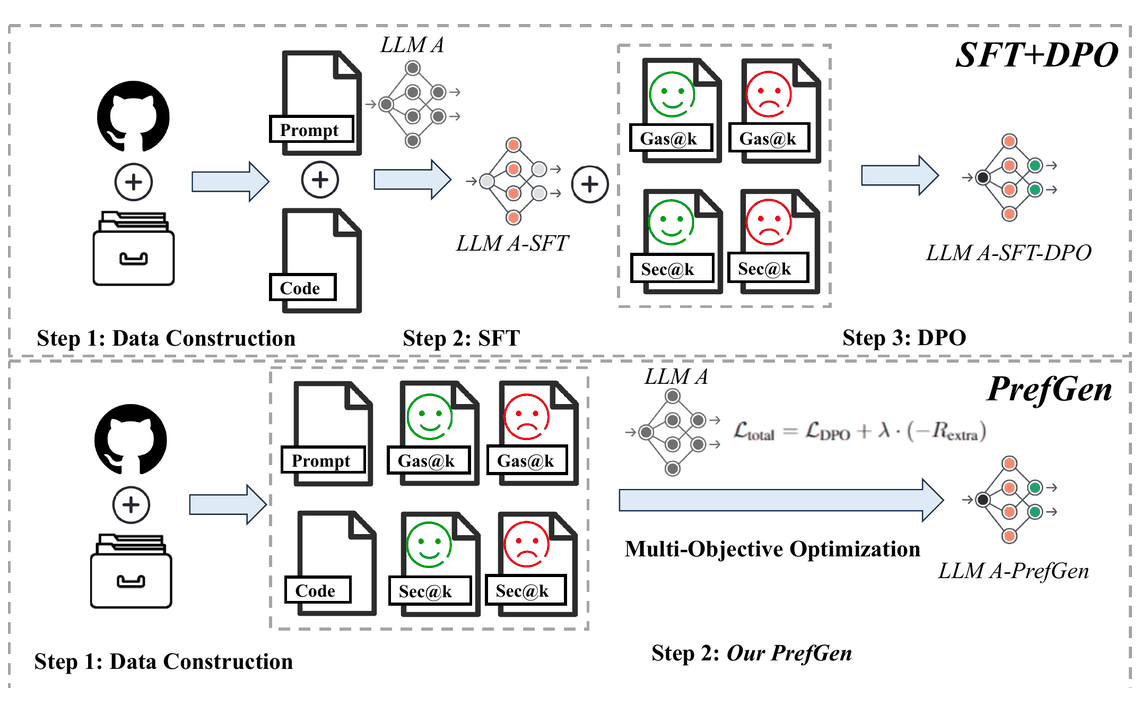
PrefGen: A Preference-Driven Methodology for Secure Yet Gas-Efficient Smart Contract Generation
Zhiyuan Peng, Xin Yin#, Zijie Zhou, Chenhao Ying, Chao Ni, Yuan Luo (# co-first author)
IEEE/ACM Automated Software Engineering Conference 2025 ASE 2025 CCF-A
A preference-driven generate-and-feedback loop that steers the model toward code satisfying two competing objectives at once: security and gas efficiency.
PrefGen: A Preference-Driven Methodology for Secure Yet Gas-Efficient Smart Contract Generation
Zhiyuan Peng, Xin Yin#, Zijie Zhou, Chenhao Ying, Chao Ni, Yuan Luo (# co-first author)
IEEE/ACM Automated Software Engineering Conference 2025 ASE 2025 CCF-A
A preference-driven generate-and-feedback loop that steers the model toward code satisfying two competing objectives at once: security and gas efficiency.
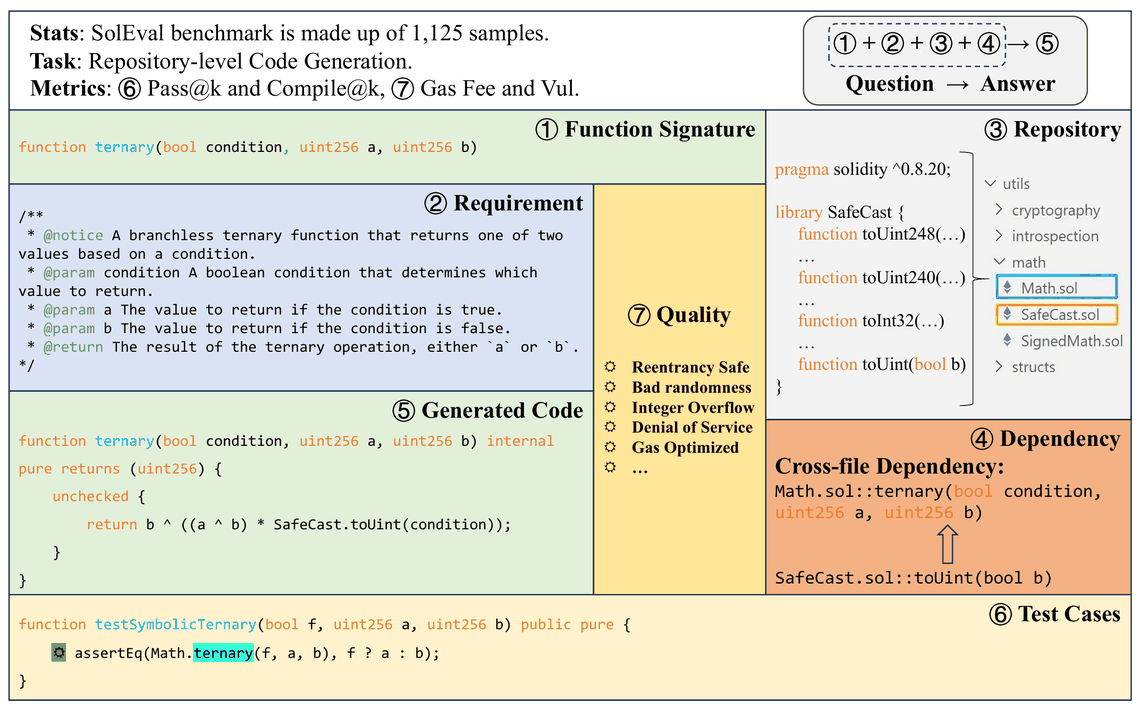
SolEval: Benchmarking Large Language Models for Repository-level Solidity Code Generation
Zhiyuan Peng, Xin Yin#, Rui Qian, Peiqin Lin, Yongkang Liu, Chenhao Ying, Yuan Luo (# co-first author)
Conference on Empirical Methods in Natural Language Processing 2025 EMNLP 2025 Main TH-CPL-A
Repository-level generation with compilation and on-chain test execution in the loop, forcing the model to resolve cross-contract dependencies before its output can run.
SolEval: Benchmarking Large Language Models for Repository-level Solidity Code Generation
Zhiyuan Peng, Xin Yin#, Rui Qian, Peiqin Lin, Yongkang Liu, Chenhao Ying, Yuan Luo (# co-first author)
Conference on Empirical Methods in Natural Language Processing 2025 EMNLP 2025 Main TH-CPL-A
Repository-level generation with compilation and on-chain test execution in the loop, forcing the model to resolve cross-contract dependencies before its output can run.
All publications
Open Source Projects


Agent Stack
- Orchestration: goal decomposition by a control agent, role-based routing, parallel multi-agent collaboration and cross-checking
- Execution: containerized worker lifecycle, per-agent isolated workspaces, permission scoping, sandboxed build-run-verify loops
- Tools & Interfaces: tool use / function calling, OpenAI-compatible API, CLI and IM (Feishu) channels, GUI interaction
- Memory & Skills: skill extraction and reuse, reusable case packages, long-term memory consolidation with diffs and safe rollback
- Observability: session transcripts, trace review, workspace and runtime inspection
Academic Service
-
Reviewer: IEEE Transactions on Software Engineering (TSE), ACM Transactions on Software Engineering and Methodology (TOSEM), Automated Software Engineering (ASE)
-
Reviewer: NeurIPS 2026, EMNLP 2026